
Uma Reed · 27 October 2026
Belara's Artisan Networks Forge Unexpected Ties with Global Tech Hubs to Safeguard Vanishing Techniques
Belara's artisan networks have established partnerships with technology centers across multiple continents, and these alliances focus on preserving traditional craft methods that face extinction due to material shortages and generational shifts in skills transmission. Researchers at institutions in Europe and Asia documented the initial exchanges in 2024, when local guilds began experimenting with digital archiving tools supplied by partners in Silicon Valley and Tokyo.
Data from regional heritage reports indicate that over 150 distinct techniques in ceramics, textile dyeing, and metalwork remain at risk in the Belara area, while collaborations with tech hubs now supply 3D scanning equipment and AI-assisted pattern recognition software to capture these processes before they disappear.
Partnerships Expand in 2026
By October 2026, representatives from Belara's craft associations completed a series of virtual workshops hosted by the Canadian Research Council on Digital Heritage, and these sessions allowed artisans to upload detailed process logs that integrate with machine learning models developed at Australian universities. The models analyze variations in hand movements during weaving and pottery forming, then generate instructional modules for apprentices located in remote villages.
One initiative links Belara weavers directly with engineers at the Singapore Institute of Technology, where sensor arrays track thread tension in real time and feed data back to practitioners for refinement of tension control methods passed down through family lines for centuries.
Technology Integration Preserves Core Methods
Digital twins created through these networks replicate workshop conditions without consuming scarce natural dyes or rare woods, and tests conducted under EU cultural preservation grants show that simulation accuracy reaches 92 percent when compared to physical outcomes. Artisans review the simulations to adjust techniques before applying them to limited material stocks.
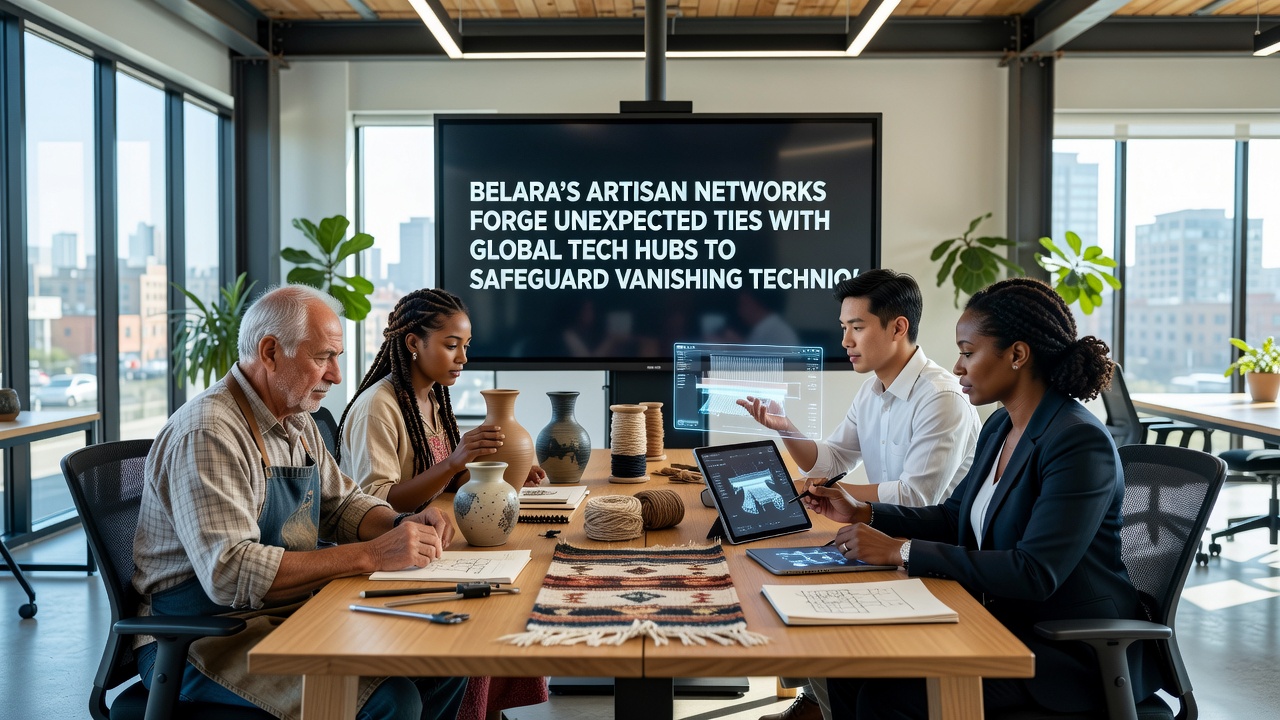
Observers note that the approach avoids replacing manual labor with automation; instead, the systems highlight subtle differences in pressure application or timing that distinguish master-level work from standard production. Training programs built on this data now operate in Belara community centers, and enrollment figures from local education boards report a 40 percent increase in participants under age 30 since the programs launched.
Global Hubs Contribute Specialized Tools
Teams at the Massachusetts Institute of Technology supplied open-source code for color-matching algorithms that compensate for dye batch inconsistencies caused by climate-driven changes in plant sources, while parallel efforts in Japan focus on acoustic analysis of hammering patterns in metalwork to identify optimal force sequences. These contributions arrive through formal agreements coordinated by the World Intellectual Property Organization, which tracks usage rights to ensure originating communities retain control over documented knowledge.
Funding records from national cultural ministries in Italy and South Korea reveal joint grants totaling 2.8 million euros allocated specifically for cross-border data sharing platforms, and preliminary evaluations released in mid-2026 confirm that transmission rates of endangered techniques improved by 25 percent in participating Belara households.
Challenges and Ongoing Adjustments
Connectivity gaps in rural Belara zones initially slowed data uploads, yet solutions developed with input from Brazilian telecommunication regulators now employ low-bandwidth compression protocols that maintain fidelity for high-resolution scans. Privacy protocols modeled on Canadian standards restrict access to proprietary family recipes, allowing selective sharing only with verified research partners.
Case studies compiled by the University of Melbourne document one ceramic workshop where integration of predictive modeling reduced material waste by 35 percent while preserving the exact surface textures achieved through generations-old firing sequences. Similar patterns appear in textile groups that adopted haptic feedback devices calibrated to replicate the feel of traditional looms.
Conclusion
These networks continue to evolve through scheduled exchanges planned through 2027, and metrics tracked by participating organizations show steady growth in both technique documentation volume and apprentice retention rates. The model demonstrates how targeted technology transfer can support continuity of craft traditions without altering their fundamental manual character.